

Maintaining the safety and operability
of your equipment in seismic environments
Seismic events, although unpredictable, pose a major risk to service continuity and the safety of industrial equipment and facilities. Faced with constantly evolving regulatory requirements and environmental changes, the seismic qualification of your equipment is essential. Entrusting your seismic testing to a COFRAC-accredited body is an indisputable source of confidence. Seismic testing provides objective proof of the structural and functional performance of your critical equipment under extreme conditions.
When conducting seismic testing, it is essential to have recognised technical expertise and state-of-the-art equipment. Your challenge: to transform seismic risk into a means of verifying the compliance and reliability of your critical and strategic industrial equipment. Our expertise, backed by that of the Apave Group, guarantees you:
- The best testing resources on the market
- Support for your studies and simulations
- The development of your teams' skills
Sopemea is the trusted and expert partner of industrial players who wish to carry out earthquake resistance testing using realistic, reliable and COFRAC-accredited seismic tests. Our laboratories with state-of-the-art equipment allow you to benefit from versatile seismic testing facilities, adapted to your constraints and needs, including:
A triaxial table (2.2 m x 2.2 m):
- Allows testing in mono, bi or triaxial mode.
- Frequency range: 0.1 Hz to 150 Hz.
- Capacity: equipment up to 2,000 kg.
- Performance: maximum speed of 1.7 m/s with displacements of 200 mm for maximum realism.
Two biaxial tables:
- A small table (1 m x 1 m) for lightweight components.
- A large table (3 m x 3 m) for bulky equipment weighing up to several tonnes.
We are also equipped with two 10-tonne overhead cranes and multiple access points to facilitate the transport of large equipment.
Addressing your
seismic challenges
We were recently asked to conduct tests as part of the Carrier-EDF project. Our client wanted to ensure the seismic resistance of critical equipment used in this project: chillers designed for emergency cooling of technical rooms in nuclear power plants in France.
From 2 to 4 June 2025, seismic validation tests were successfully carried out on Carrier's new AquaForce®30XF chiller.
Conducting these seismic resistance tests was a major challenge for the Carrier Group: to guarantee the resistance and optimal functioning of its machines, even in the event of an earthquake, in order to meet EDF DIPDE's specifications. These chillers are intended for emergency cooling of technical rooms in nuclear power plants in France.
- Test preparation
Test preparation
- Testing
Testing
- After testing
After testing
- Test preparation
Test preparation
- Testing
Testing
- After testing
After testing
- Test preparation
Test preparation
- Testing
Testing
- After testing
After testing
Ensuring the continuity of your services:
our seismic testing meets your sector-specific requirements
Seismic qualification is a major challenge and a regulatory requirement in all areas where service continuity and safety are non-negotiable. We support you with a rigorous methodological approach, based on our expertise, to meet the most stringent specifications in your sectors.
Expertise in nuclear seismic testing: safety, qualification and compliance
- Your need: to validate the performance of your equipment during and after the application of an earthquake spectrum
- The requirement: performance under normal and post-accident conditions
- Our solution: mono-, bi- or triaxial tests for realistic simulation in accordance with nuclear industry requirements
- Standards mastered: RCC-E, IEEE 344, etc.
- Your benefit: completion of the entire process, from ageing your equipment in accordance with IEEE 323 to seismic qualification testing, in a single location, thereby simplifying your approach.
Testing equipment
that meets your needs
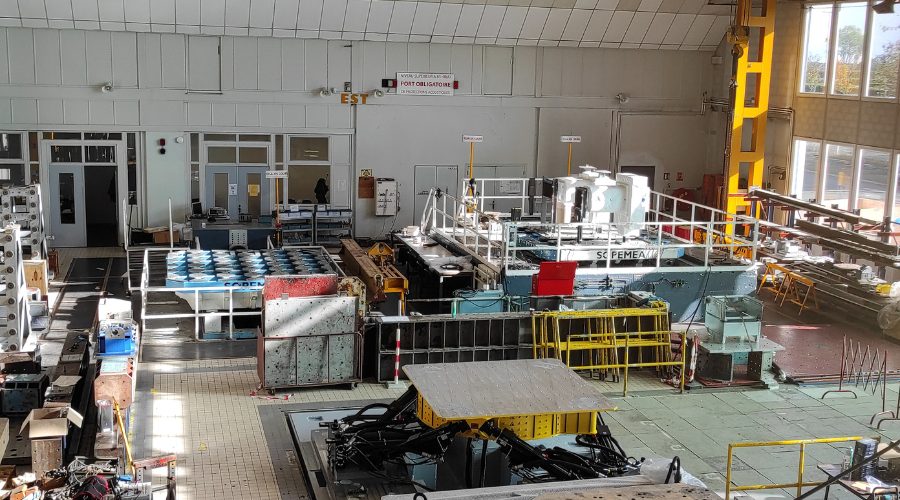
High-performance and capable of accommodating equipment of all sizes, our testing equipment is designed to ensure the reliability of your results. Our testing equipment includes a triaxial table, used mainly for seismic testing. This table enables Sopemea to carry out tests that are:
- Realistic: representative of the actual stresses encountered during earthquakes
- Accurate: close to numerical calculations and industrial simulations
- Compliant: meeting the requirements of standards
- Efficient: offering increased production capacity to secure your qualifications
The triaxial table can be used to perform mono-, bi- or triaxial tests on equipment weighing up to 2,000 kg. It reaches a maximum speed of 1.7 m/s with displacements of 200 mm, ensuring maximum realism. We also have two biaxial tables: a biaxial table (1 m x 1 m) for testing lightweight components and a biaxial table (3 m x 3 m) for testing large equipment weighing up to several tonnes. The Vélizy laboratory is equipped with two 10-tonne overhead cranes and several access points within the halls for transporting your large equipment.
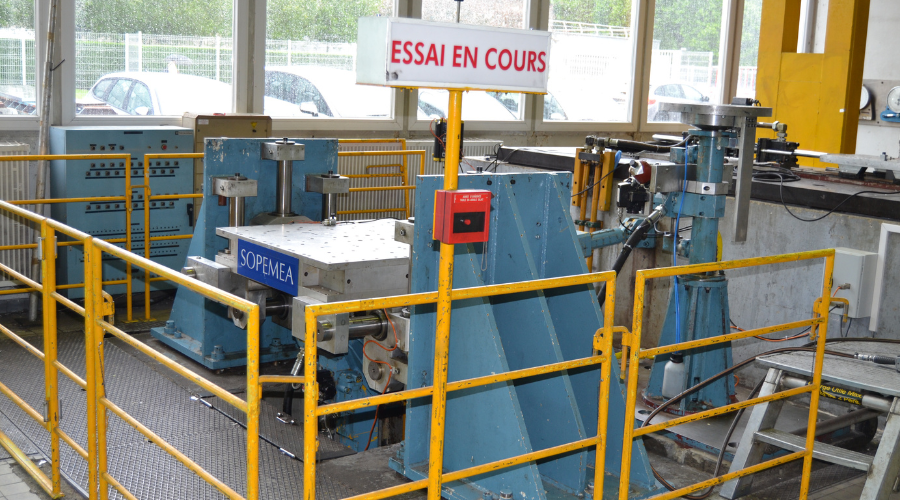
This variety of resources allows us to meet your seismic qualification testing needs :
- Reproduction of complex earthquake movements: we perform tests on our tables in mono, bi or triaxial mode in order to reproduce earthquake movements as accurately as possible.
- Synthesis of accurate accelerograms: we use time signals to generate shock response spectra (SRC) that provide complete and accurate coverage of the spectral envelope, ensuring the normative validity of your equipment's qualification.
- Advanced instrumentation and functional analysis: we take measurements using accelerometric sensors to assess the structural behaviour of your equipment and verify the functionality of your system during and after the earthquake to ensure its operability.
By using these methods, the Sopemea teams give you a decisive competitive advantage in your project management while verifying the robustness and reliability of your equipment.
Understanding the seismic
testing process







Our experts answer your questions
about seismic testing
-
What is a seismic test?
A seismic test is a laboratory simulation designed to verify the performance of equipment subjected to an earthquake. It is essential for the safety qualification of critical equipment. The objective is to ensure that the equipment remains operational during and after an earthquake, or that it switches to the designated safety mode to guarantee the integrity of the overall system. -
What is the difference between a biaxial test and a triaxial test?
The biaxial test simulates movement on two axes simultaneously. The triaxial test reproduces seismic movement simultaneously on all three axes (X, Y, and Z) and provides more realistic multi-axis simulations, particularly for low-frequency tests and large displacements. -
Is aging taken into account in nuclear seismic qualification?
Yes, absolutely. According to standards such as IEEE 323 and IEEE 344, Class 1E nuclear equipment must often undergo an accelerated aging process (simulating the effects of temperature, pressure, and time) before undergoing the final seismic test. This ensures that the equipment will retain its mechanical and electrical properties at the end of its nominal service life. -
What is the SRC (Shock Response Curve)?
The SRC is a graphical representation of the maximum accelerations that a piece of equipment can undergo at different frequencies during an earthquake. During testing, the laboratory must ensure that the SRC generated (SRG) by the test bench envelopes (is greater than or equal to) the SRC required (SRE) by the customer's specifications or by the standard (e.g., SRE related to the Safety Majorized Earthquake - SMS). -
Does Sopemea offer support prior to seismic testing?
Our offer includes an engineering and digital simulation phase. We can perform modal analyses and seismic calculations. This allows us to predict the behavior of your equipment, validate the test equipment, and optimize the seismic qualification protocol.
-
What are the main seismic testing standards applied by Sopemea?
Seismic qualification requires compliance with extremely rigorous standards. With our expertise in critical sectors, we have mastered and apply the main seismic testing standards:
- IEC/IEEE 60980-344 (USA)
- RCC-E (EDF)
- RCC-M (EDF)
- KTA (Germany)
- GR-63 CORE (TELCORDIA USA)
- IEC 60068-3-3 (International)
- BTR 91C112 (EDF)
- STD 7426 (ORANO)
Why
choose Sopemea?
A complete range of tests and related services
+ Over 75 years' experience in qualification testing